
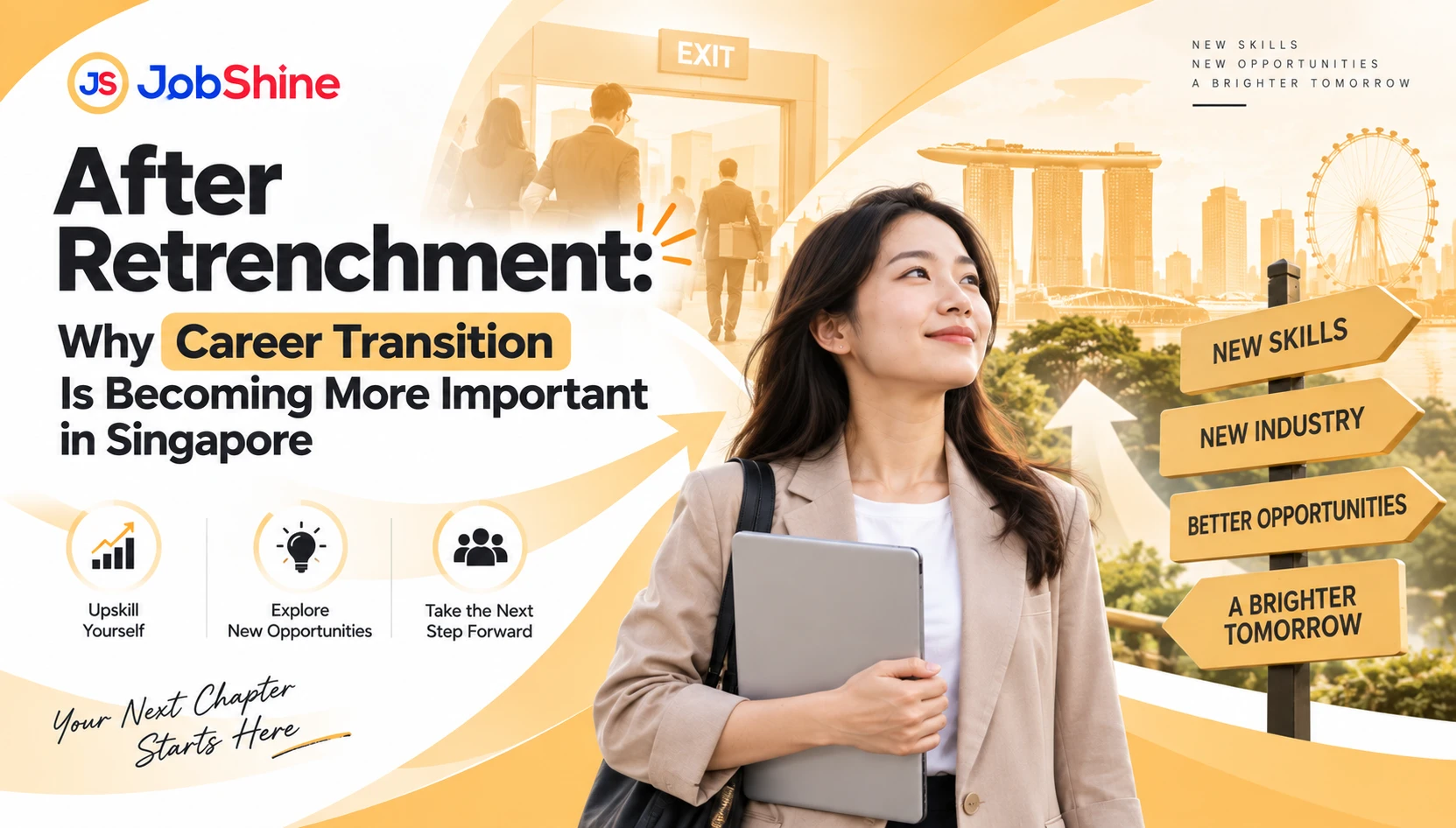
Losing a job can feel like the end of a career.
But in Singapore's changing labour market, retrenchment increasingly means something else: a transition to a different role or industry.
New Ministry of Manpower data shows that workers retrenched from Singapore's e-commerce and tech-enabled sectors are returning to employment more quickly — their six-month re-entry rate improved from 53% in Q4 2025 to 61% in Q1 2026.
Many workers are not remaining unemployed indefinitely. They are finding ways to move into new opportunities.
One common mistake after losing a job is to think:
"My experience is only useful in my previous industry."
That's rarely true.
A worker from e-commerce may have experience in:
Many of these skills can transfer directly to other industries — the job title changes, but the capability doesn't.
Imagine someone who worked as an e-commerce operations executive. Their previous job title may no longer be relevant to a new employer — but the underlying skills could be:
Recruitment should focus not only on where someone worked — but on what they learned to do.
Even when workers have transferable skills, changing industries isn't always easy:
This is where structured career transition programmes can make a real difference.
MOM has highlighted several programmes available to workers who require significant reskilling:
Career Conversion Programmes can also provide employers with salary support when training mid-career career switchers who do not yet have the full skill set required for a new role.
This creates an important opportunity for employers — instead of hiring only fully experienced candidates, businesses can consider candidates with strong transferable skills and train them for the role.
Government support reduces the risk of hiring a career switcher — making it a smarter option than many employers realise.
Career switchers bring something that a completely inexperienced candidate may not have: workplace experience.
They already understand:
They may simply need to learn the technical requirements of a new industry.
For many employers, that is a worthwhile trade-off — and a faster path to a reliable employee than starting from scratch.
If you've recently been retrenched, don't rebuild your CV from scratch.
Instead, identify your transferable skills. Ask yourself:
Then look for industries where those skills are relevant.
This approach can reveal opportunities that wouldn't appear if you searched only for your previous job title.
Traditional recruitment often works like this:
Job title → Candidate with same job title
But career transitions require a different approach:
Skills → Experience → Potential → New role
That can open up a much larger talent pool — and help employers find candidates who are motivated to build a new career.
The best hire isn't always the one who has done this exact job before. Sometimes it's the one who is ready to grow into it.
For employers, Jobshine helps connect businesses with candidates who have relevant experience across different operational roles.
For jobseekers, it creates opportunities to discover roles beyond their previous job titles.
Because the next job doesn't always have to be the same job. Sometimes, the best career move is a new direction.
Singapore's labour market is changing. Industries are restructuring. Technology is changing jobs. And workers are increasingly having to move between roles and sectors.
The ability to transition is therefore becoming an important part of career resilience.
Your previous job is part of your experience — not the limit of your future.
Partner with Jobshine to build a stronger, more stable team: www.jobshine.sg
#CareerTransition #JobSearch #SingaporeJobs #Hiring #Recruitment #TalentAcquisition #Workforce #SkillsBasedHiring #BlueCollar #JobSeekers #HumanResources #HR #SingaporeRecruitment #HiringStrategy #JobShine

