
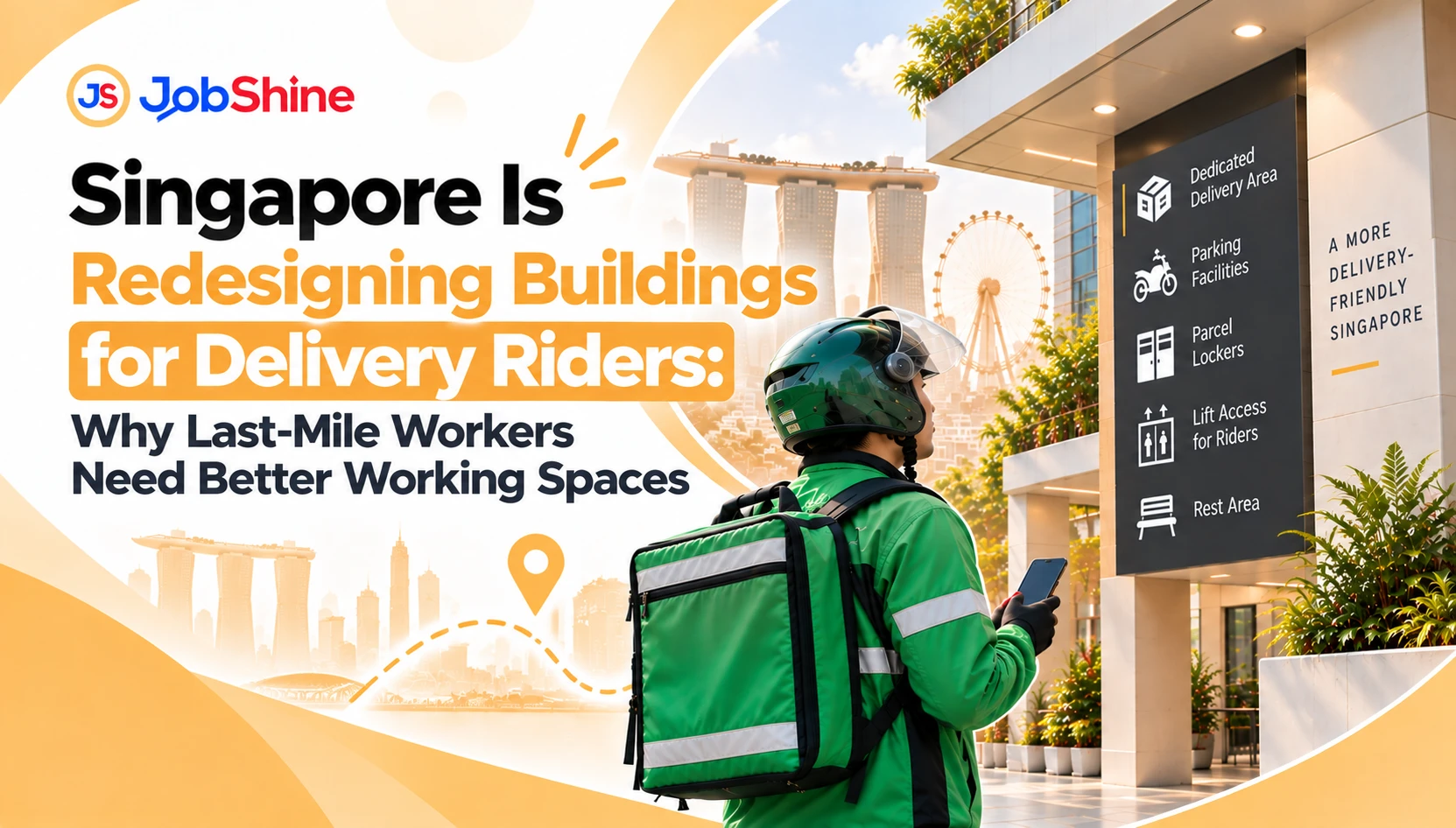
For a delivery rider, the hardest part of a delivery is not always the journey.
Sometimes, the biggest challenge starts after arriving at the destination.
Finding somewhere to park, entering a condominium, locating the correct block, and waiting for a customer can add significant time to a single delivery.
Singapore is now looking at how buildings themselves can make last-mile deliveries easier.
In September 2026, the Urban Redevelopment Authority (URA) issued a Last-mile Delivery Guide for Developments — encouraging developers, building owners, and property managers to adopt design and operational practices that improve delivery experiences.
Delivery workers operate differently from ordinary visitors.
A rider may need to:
When buildings are not designed with deliveries in mind, these tasks can become complicated — and time-consuming.
Delivery riders welcomed new recommendations for dedicated parking spaces and collection points because they reduce the time and difficulty involved in completing deliveries.
The new guidelines encourage developments to consider facilities such as:
Delivery Waiting Bays
Dedicated spaces where delivery riders can temporarily park while completing an order — with a recommended free parking grace period of at least 15 minutes.
Collection Points
Designated areas near entrances or guardhouses where parcels or food can be collected — reducing the need for riders to navigate deep into a building.
Clear Wayfinding
Signs and layouts that help delivery workers find the correct location more easily — reducing confusion and saving time.
The recommendations are intended to improve the delivery experience for riders, residents, tenants, and building security officers alike.
Time is an important part of delivery work.
A rider may be paid for completing deliveries — meaning unnecessary waiting directly affects productivity.
Consider a rider arriving at a condominium but being unable to park nearby:
Multiply that process across dozens of deliveries — and small delays become a major part of the working day.
Better-designed delivery facilities could help riders complete more deliveries, earn more, and finish their shifts faster.
The issue is not only efficiency.
Delivery riders frequently work around roads, loading bays, car parks, pedestrians, and moving vehicles. A rider rushing to complete an order may face additional risks when navigating unfamiliar or congested spaces.
Dedicated delivery areas could provide a more organised environment for stopping and collecting orders.
Singapore has also recently introduced a safety programme specifically for delivery workers — covering situations such as riding with loaded delivery bags, frequent stop-start journeys, and navigating tight spaces.
Together, these developments show increasing attention toward the working conditions of delivery workers — not just their output.
Consumers increasingly expect goods and meals to arrive quickly. This has created a workforce that operates between businesses and customers every day.
The final stage — getting the product from a local facility or business to the customer — is known as last-mile delivery. It may be the shortest part of the supply chain, but it can also be one of the most operationally challenging.
Last-mile workers are not a convenience. They are a critical part of how Singapore's economy moves.
Not every building can immediately create new delivery facilities.
Experts noted that older or smaller condominiums may face limitations related to space, cost, security, and existing infrastructure.
Implementation will not look the same everywhere — but the direction is clear.
For companies relying on delivery workers, operational efficiency increasingly depends on more than the worker themselves.
Businesses also need to consider the environment in which their workers operate.
Better coordination between Employer + Building + Customer + Delivery Worker can potentially reduce unnecessary waiting and improve the overall delivery process.
A well-supported delivery worker is a faster, safer, and more productive one.
For people considering delivery and logistics work, the job is more than simply knowing how to ride or drive.
Successful delivery workers may also need:
As the industry becomes more organised, these skills can become increasingly valuable — and increasingly recognised.
Singapore's new delivery guidelines are not yet mandatory — implementation will depend on individual developments. But the direction is significant.
The city is increasingly considering the needs of the workers who move products through its buildings every day.
Better infrastructure creates a better working environment — and better working environments support more efficient businesses.
For delivery workers, small changes such as a proper waiting bay or collection point could make a surprisingly big difference to the working day.
Jobshine helps jobseekers discover employment opportunities across Singapore — including roles in logistics, delivery, and other operational sectors: www.jobshine.sg
#DeliveryRiders #LastMileDelivery #LogisticsJobs #PlatformWorkers #SingaporeJobs #BlueCollar #JobShine

