
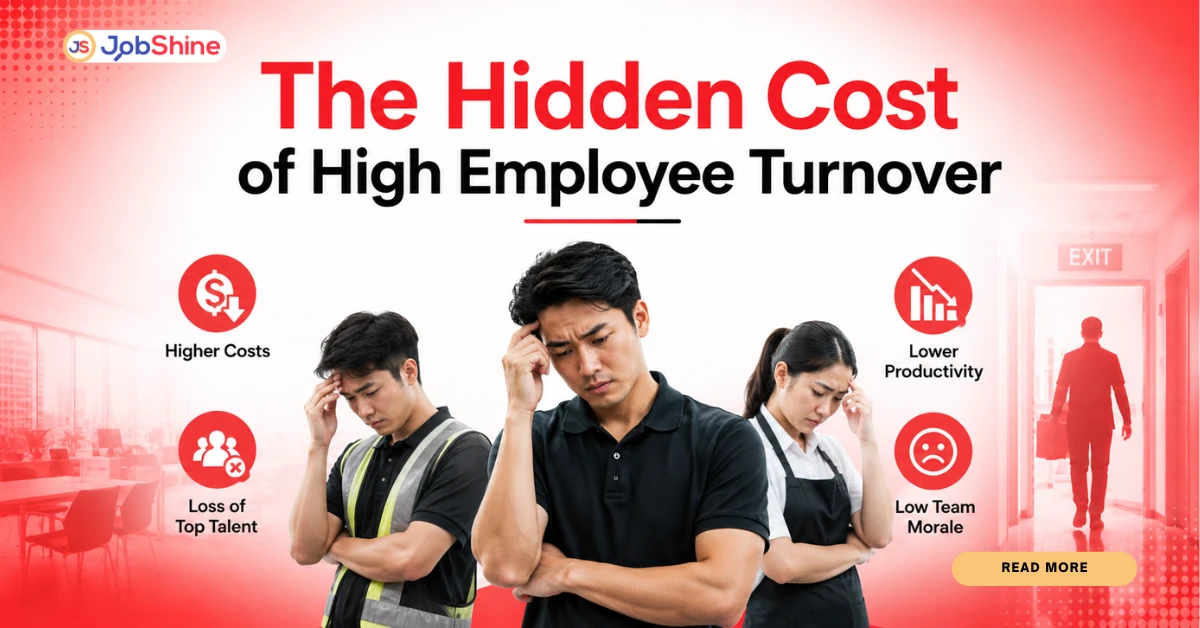
Employee turnover isn't just an HR statistic — it's a business cost that quietly eats into productivity, morale, and revenue.
Many SMEs in Singapore underestimate how expensive turnover really is, until it starts affecting daily operations, client relationships, and team stability.
Replacing an employee costs far more than the recruitment fee. Consider:
Studies consistently show that replacing an employee can cost anywhere from 20% to 200% of their annual salary, depending on the role's complexity.
For SMEs operating on tight margins, this cost is rarely accounted for — until it starts repeating.
It often helps to see this from the employee's side. As one worker shared after leaving a job within months of joining:
"I didn't leave because of the salary — I left because no one ever explained what growth here would look like."
This is a common pattern: employees don't always quit over pay — they quit over unclear direction and unmet expectations set during hiring.
When the employee's understanding of the role doesn't match reality, disengagement often starts within the first few weeks — long before an official resignation.
The root of many turnover problems starts at the hiring stage, not the exit interview.
Companies that invest in structured, values-aligned hiring processes tend to retain employees longer because:
This shifts retention from being a post-hire fix to a pre-hire strategy — addressing the root cause instead of managing the symptoms.
Reducing turnover isn't about working harder to retain people — it's about hiring smarter from the start.
The right hire, made with the right process, is your most cost-effective retention strategy — saving both money and operational stability in the long run.
Retention doesn't start at the exit interview. It starts the moment you post the job.
At Jobshine, we help businesses hire candidates who are not just qualified — but built to stay.
Partner with Jobshine to build a stronger, more stable team: www.jobshine.sg
#EmployerBranding #HRSingapore #TalentRetention #HiringStrategy #JobshineSG

