
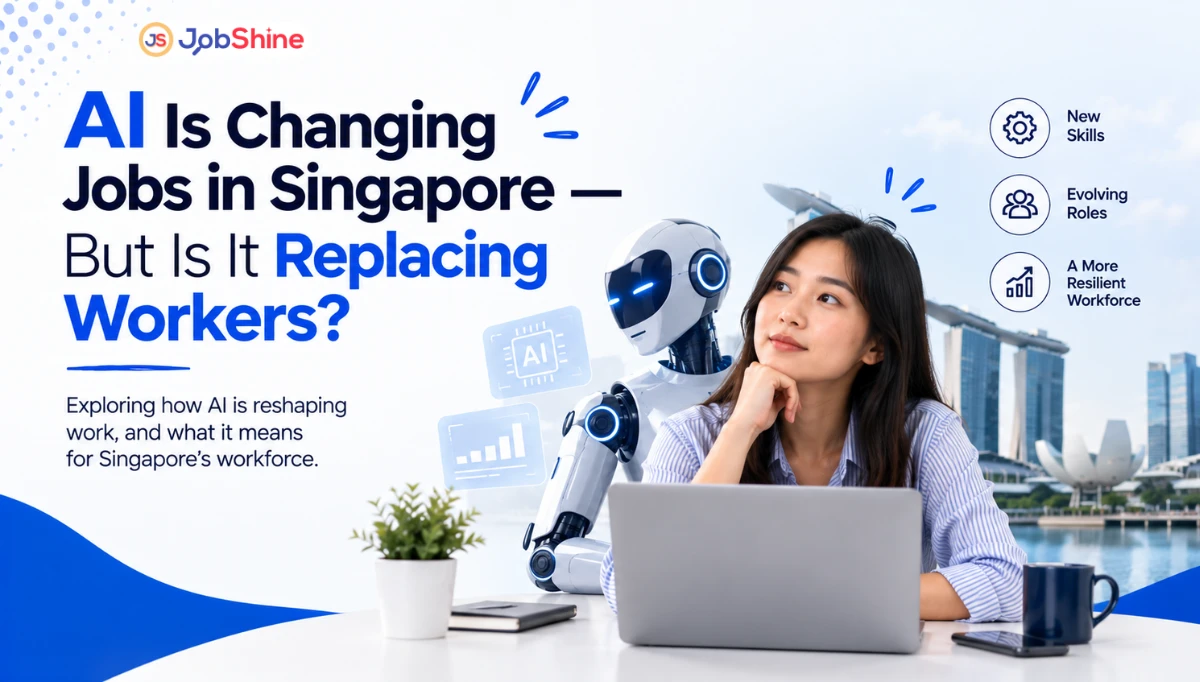
Artificial intelligence has become one of the biggest conversations in the world of work.
Many workers worry that AI will eventually replace their jobs. But current evidence suggests a more complicated picture: AI is changing jobs, rather than simply eliminating them.
Recent research and labour-market discussions show that large-scale job losses caused directly by AI have not yet materialised. Instead, employers are changing workflows, increasing productivity expectations, and looking for workers who can adapt to new technology.
AI can automate certain tasks without eliminating an entire job.
For example, technology may help with:
The worker remains — but spends less time on repetitive tasks and more time on activities that require judgement, communication, or physical execution.
AI isn't removing the worker from the equation — it's changing what the worker does.
AI is not only an office-worker issue.
Technology is increasingly appearing in warehouses, factories, logistics operations, facilities management, and other frontline environments.
Workers may need to operate digital systems, automated equipment, or technology-assisted processes.
This means digital literacy is becoming increasingly useful — even in traditionally hands-on jobs.
As technology changes workplaces, employers may increasingly look for workers who combine practical skills with:
The strongest candidates may not necessarily be the ones who already know every technology.
They may be the ones who are willing and able to learn.
Companies should not think of AI only as a replacement tool.
They can also use technology to help existing employees become more productive.
Training, job redesign, and internal upskilling can help businesses prepare their workforce for the next stage of digital transformation.
The most future-ready businesses won't be the ones that replaced their people with technology — they'll be the ones that prepared their people for it.
AI may change the way people work — but technology alone cannot replace reliability, judgement, teamwork, and human interaction in every job.
The future workforce will likely be a combination of people and technology working together.
For employers, the challenge is finding workers who can grow alongside that change.
The question was never "AI or people?" — it was always "how do people and AI work best together?"
Partner with Jobshine to build a stronger, more stable team: www.jobshine.sg
#AI #ArtificialIntelligence #FutureOfWork #Workforce #Skills #Upskilling #Reskilling #Employment #SingaporeJobs #SingaporeRecruitment #Hiring #Recruitment #TalentAcquisition #HR #HumanResources #JobShine

