
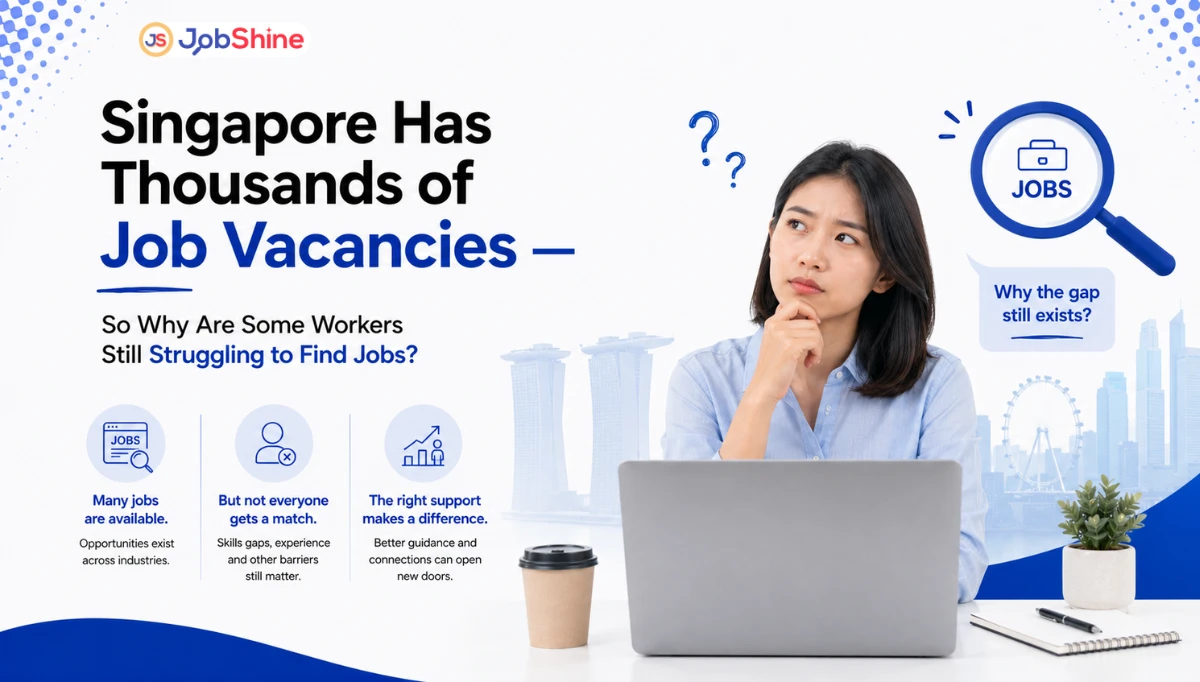
Singapore's labour market has an interesting problem.
There are still many job vacancies — yet some groups of jobseekers continue to struggle to find suitable employment.
Data from Q1 2026 showed 73,300 job vacancies, while unemployment among residents aged below 30 reached 6.2%. This suggests that the challenge may not simply be a lack of jobs — but a mismatch between available jobs and available talent.
A vacancy can exist without being suitable for every jobseeker.
The problem can involve:
This creates a situation where companies are hiring — while some workers are still searching.
Employers may have vacancies, but they need people who can perform specific tasks. At the same time, jobseekers may have qualifications or experience that don't directly match the roles currently in demand.
This is why skills-based recruitment is becoming increasingly important.
Instead of only asking:
"What qualification does this candidate have?"
Employers can also ask:
"What can this candidate actually do?"
A candidate's potential is often more valuable than their previous job title.
The mismatch can also be an opportunity for frontline and blue-collar workers.
Many operational roles value practical skills, reliability, communication, and willingness to learn — not just formal qualifications.
Candidates who are open to different industries or willing to develop new skills may be able to access opportunities beyond their previous job titles.
In blue-collar hiring, what you can do often matters more than where you've been.
Companies can make recruitment more effective by:
A broader approach helps employers reach strong candidates they may otherwise overlook.
Singapore may not simply have a shortage of jobs.
In some areas, the bigger challenge is connecting the right workers with the right opportunities.
Better matching can benefit both sides: employers find suitable talent faster, while jobseekers gain access to opportunities that better fit their skills.
That is where smarter recruitment can make a real difference.
Partner with Jobshine to build a stronger, more stable team: www.jobshine.sg
#JobMatching #SkillsBasedHiring #Hiring #Recruitment #SingaporeJobs #SingaporeRecruitment #TalentAcquisition #Workforce #Employment #HR #HumanResources #HiringStrategy #BlueCollar #SkilledWorkers #SingaporeBusiness #JobShine

