
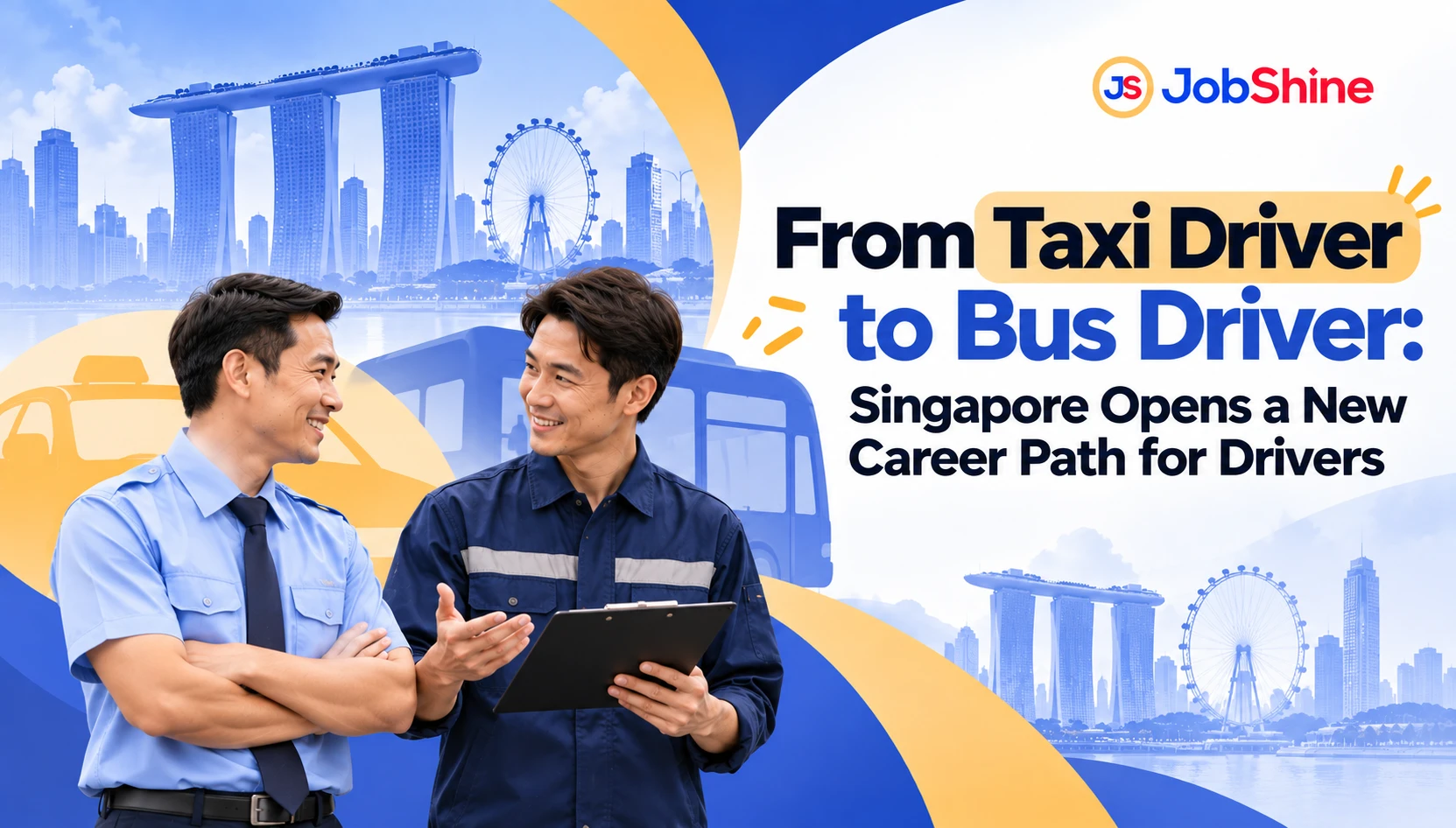
For taxi drivers and private-hire vehicle (PHV) drivers in Singapore, a new career pathway has opened.
Starting 1 October 2026, eligible taxi and private-hire drivers can sign up for a new programme that allows them to transition into bus-driving careers — building new skills while preparing for changes in Singapore's transport industry.
The new programme can be completed either part-time or full-time and lasts between two and six months, depending on the participant's background and qualifications.
Drivers who already hold a Class 4 licence may qualify for a shorter training period.
The training combines practical experience with on-the-job learning. Participants can also develop skills related to:
This programme is not simply about learning how to drive a larger vehicle — it is about preparing workers for a different type of transport career.
Singapore's transport industry is changing rapidly.
Autonomous vehicles, electric vehicles, and digital transport systems are gradually becoming part of the transportation landscape. For drivers, this creates both challenges and opportunities.
Instead of waiting for technology to change their existing jobs, workers can develop new skills that are relevant to the future transport industry.
The new bus-driver pathway is one example of how Singapore is helping workers move forward — rather than simply move aside.
One interesting aspect of this transition is the difference between platform-based driving and bus driving.
Private-hire driving can offer flexibility — but income and working hours can vary. A bus-driving position can provide a more structured employment arrangement, including employment benefits and training opportunities.
One former private-hire driver shared that he moved into bus driving after experiencing long hours and unpredictable income while working in ride-hailing. He now works around 10 hours a day and receives employment benefits such as medical benefits and training.
This doesn't mean one type of work is better for everyone. It highlights the importance of having multiple career options.
Existing drivers already possess skills that can be valuable in other transport roles:
The challenge is translating these existing skills into a new occupation — and training programmes can help bridge that gap.
Years behind the wheel is experience. The question is how to make that experience work in a new direction.
Technology is often discussed in terms of jobs disappearing. But Singapore's driver transition programme shows another possibility.
As transport technology develops, workers may need to move from one occupation to another — or combine existing experience with new technical skills.
For example, a driver today may eventually work in:
Bus Operations → EV Operations → Fleet Management → Transport Technology
Technology creates pressure to move — but it also creates a path to move into. The workers who follow that path will be the ones who stay ahead.
Singapore is also increasing incentives to attract local bus drivers.
From 1 January 2027, eligible new Singaporean and permanent-resident bus drivers will receive:
These changes are expected to bring average monthly pay for new bus drivers to more than S$4,000 — including overtime and allowances.
Existing bus drivers will also receive a one-time pay increase.
For drivers considering the transition, the financial case is becoming increasingly strong.
This development offers an important lesson for workers in Singapore:
Your current job does not have to define your future career.
A driver with years of road experience may have a strong foundation for another transport occupation. The key is identifying:
The next career opportunity often starts with the skills you already have.
Employers can also benefit from looking beyond traditional candidate profiles.
Instead of searching only for people who already have experience in a specific position, companies can consider candidates with transferable skills and provide targeted training.
This can be particularly useful in industries where experienced workers are available but may need additional technical or operational knowledge.
The best candidate isn't always the one who already knows the job — sometimes it's the one who already knows the most important parts of it.
Singapore's transport workforce will continue evolving as electric vehicles, automation, and digital systems become more common.
The most valuable worker may not simply be someone who already knows today's job. It may be someone who can learn the next one.
For job seekers, upskilling should not only be viewed as a way to protect an existing career — it can also be a way to open a completely new one.
Sometimes, the best move forward is not a bigger version of where you are. It's a completely different direction — built on everything you already know.
Jobshine helps job seekers discover employment opportunities in Singapore and connect their existing skills with new career opportunities: www.jobshine.sg
#SingaporeJobs #SingaporeJobMarket #DrivingJobs #BusDriverJobs #BusCaptain #TaxiDriver #PHVDrivers #TransportJobs #CareerOpportunities #CareerTransition #CareerDevelopment #Upskilling #BlueCollar #Workforce #Recruitment #JobSeekers #JobShine

