
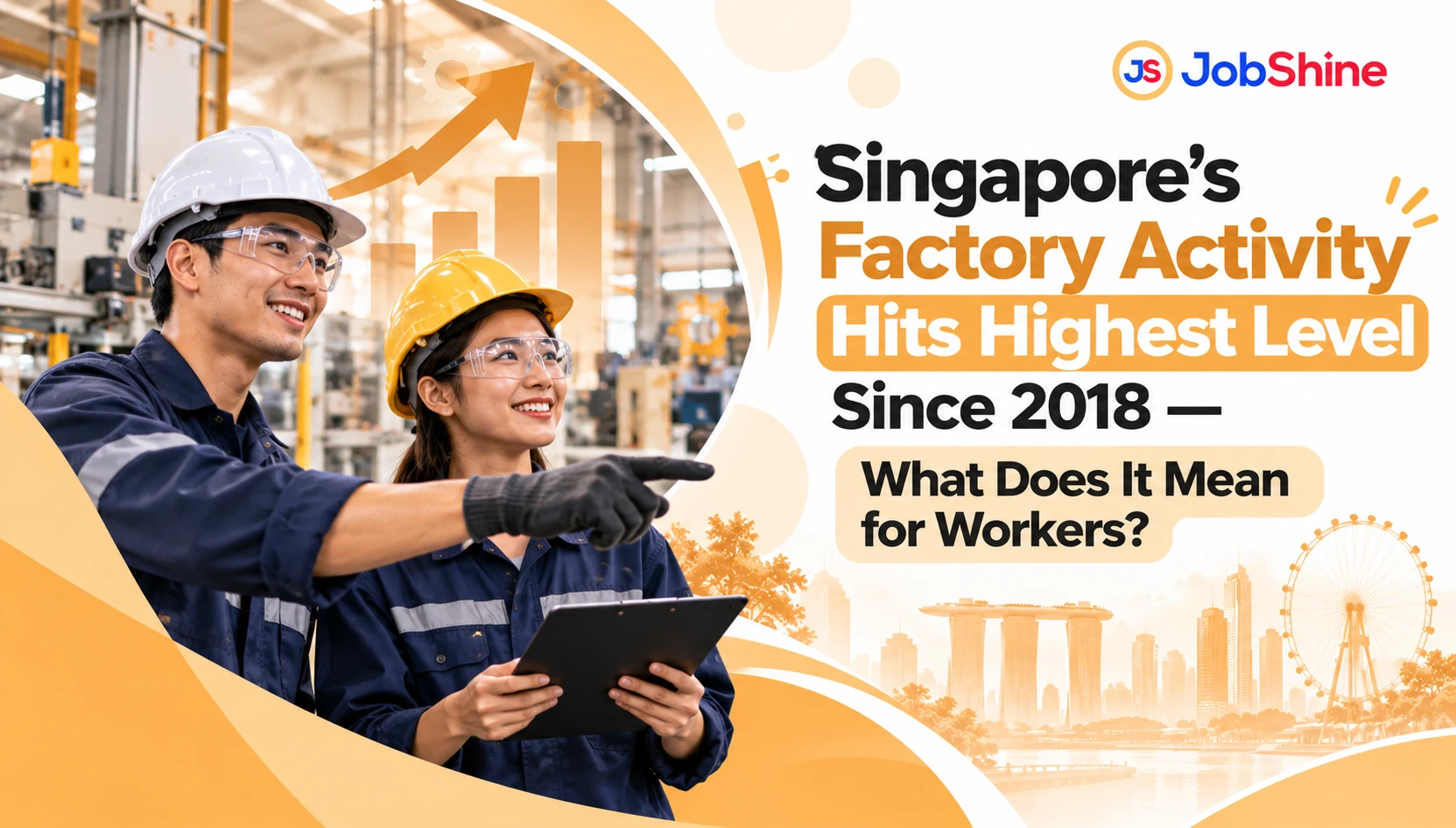
Singapore's manufacturing sector has started October with a strong signal.
Factory activity expanded for the 14th consecutive month in September 2026, with Singapore's Purchasing Managers' Index (PMI) rising to 51.7 — up from 51.5 in August and the highest reading since October 2018.
For workers and job seekers, this development matters because the latest expansion was accompanied by stronger orders, production, and employment — particularly in the electronics sector.
The latest expansion has been strongly connected to demand related to artificial intelligence.
AI requires large amounts of computing infrastructure — including semiconductors, servers, and other electronic components. This has created stronger demand across parts of the global electronics supply chain.
Singapore's electronics sector has therefore become an important beneficiary of the increase in AI-related demand — supporting stronger new orders, output, and employment.
When AI grows globally, Singapore's electronics factories feel it — and that creates real jobs on the ground.
When factories receive more orders, companies generally need to increase production capacity — and that creates demand for workers across different parts of the operation.
Potential areas include:
Not every new manufacturing opportunity requires an engineering degree. Many operational roles depend on practical skills, attention to detail, safety awareness, and the ability to work with machinery and production systems.
Today's factory worker may work alongside sophisticated equipment and automated systems:
This means manufacturing workers increasingly need a combination of:
Practical skills + Technical awareness + Digital literacy
The factory floor of 2026 is not the factory floor of 2006 — and the workers who thrive will be the ones who understand that difference.
One important point is that AI-related economic growth does not only benefit AI engineers.
The AI ecosystem requires physical infrastructure:
The more useful question for job seekers isn't just "AI is growing" — it's:
"What industries and operational roles are growing because of AI demand?"
Workers interested in manufacturing or logistics can consider building skills such as:
Machine Operation
Understanding production equipment and operating procedures.
Quality Control
Checking products against required standards and spotting issues early.
Safety
Following workplace safety procedures and identifying hazards before they become problems.
Digital Skills
Using production, inventory, or warehouse systems confidently.
Maintenance
Understanding basic equipment maintenance and troubleshooting.
Teamwork
Working efficiently with production, warehouse, and engineering teams.
These skills can be valuable across different operational environments — and they travel with you from job to job.
As factories become more automated, employers may increasingly need workers who are comfortable learning new systems.
A candidate with strong work discipline and willingness to learn may be able to adapt to new equipment faster than someone who is resistant to technology.
This makes trainability an increasingly important factor in recruitment — sometimes more important than prior experience.
The strong September PMI reading does not mean every manufacturing company is expanding at the same pace.
Singapore's manufacturers continue to face external risks, including supply-chain disruptions and energy-related pressures linked to geopolitical developments.
The latest data shows strong momentum — but job seekers should still research specific companies and sectors rather than assuming all manufacturing is equally buoyant.
For workers looking for operational jobs in Singapore, the latest manufacturing data provides another reason to pay attention to sectors connected to electronics and advanced production.
Instead of searching only by job title, job seekers can look at the industries behind current demand:
AI growth → Electronics → Manufacturing → Logistics → Warehouse → Maintenance
One industry's growth can create opportunities across an entire supply chain — and you don't have to be at the top of that chain to benefit.
The factory of the future will probably look very different from the factory of the past — more automation, more digital systems, more sophisticated machinery.
But still, people.
People will be needed to operate systems, monitor production, solve problems, maintain equipment, and keep supply chains moving.
The future factory may be more automated — but it still needs skilled people behind the machines.
Jobshine connects job seekers with employment opportunities across Singapore — including operational, logistics, and frontline roles: www.jobshine.sg

